


At-home clinical trials have the potential to improve how research studies are conducted and the level of participation they receive. Learn more about this option and whether it’s appropriate for ophthalmic studies.
What At-Home Clinical Trials Look Like and How They Fit Into Clinical Research
At-home clinical trials, a type of decentralized clinical trial, allow participants to join a study from home using the latest technology. From wearable medical devices to apps that capture real-time data, it’s possible for patients to participate without traveling to the trial site. At-home clinical trials are a patient-centric extension of clinical research.
One reason these studies are so beneficial is that they reduce a significant burden for potential clinical trial participants. In a traditional trial, they would have to come to the research site regularly. That could mean taking time off from work, finding transportation (if they don’t have reliable options), and seeking child care or other services.
For many, traveling is an expense that they can’t afford, as is hiring someone to watch their children or other loved ones. This financial burden would prevent them from joining, therefore limiting the patient demographics that your trial would have access to.
With at-home clinical trials, this burden is less of a problem. Participants will not have to travel as often to the research site, boosting diversity in participation and improving retention.
Ophthalmic exams pose some challenges that don’t allow for fully virtual trials, however. Assessments are complex and require calibrated equipment operated by trained technicians.
That is why having a hybrid model can be the best option. These research studies combine at-home assessments with visits to convenient mobile hubs and in-person visits to the research facility or to participants' homes when needed.
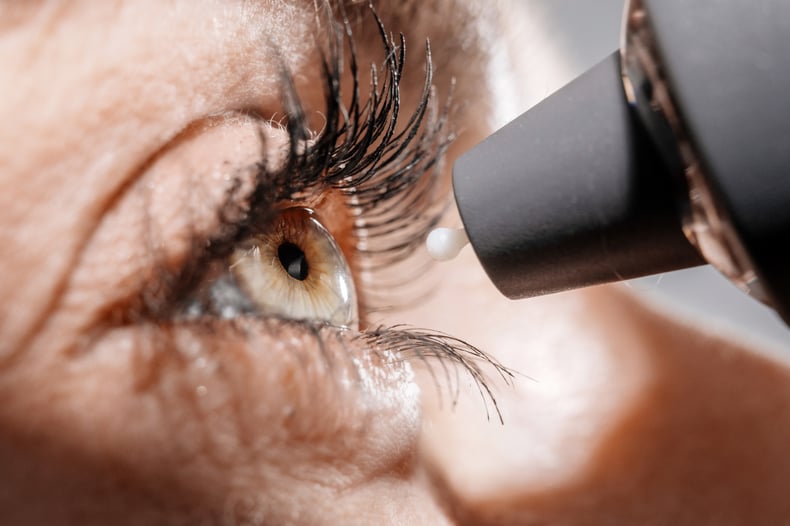
Can Ophthalmic Exams Be Done at Home?
Clinical studies with at-home components require researchers to have a clear understanding of what participants can feasibly do. Not all assessments can be performed outside of a clinic.
One of the most effective things that at-home trials can accomplish is data collection. At-home clinical trials rely heavily on real-time data collected through wearable technology and apps.
A viable assessment for ophthalmic clinical trials is best-corrected visual acuity (BCVA) because it doesn’t require specialized equipment. Even with a relatively simple assessment such as an acuity test, there could still be concerns.
It can be challenging to standardize results when researchers have no control over the environments in which assessments are conducted. Research participants need significant guidance and the right digital tools.
It’s also essential to stress the importance of patient adherence to the trial’s requirements while providing strategies to help them meet them.
Basic Check-Ins and Patient-Reported Outcomes
At-home clinical trials typically include ePRO and symptom-tracking services, which can be done through various apps.
Another strategy that works during the at-home portion of a trial is telehealth follow-up. Telehealth relies on virtual consultations to ensure participants get answers to their questions while also allowing researchers to monitor patients.
Instead of asking participants to travel on-site to check in with healthcare providers or researchers every few days, these virtual options reduce the burden on everyone. This results in better participation, especially in observational studies that require fewer assessments. These are clinical trial solutions that can boost retention.
What Does Not Belong at Home for Ophthalmic Trials?
There are still three main types of assessments that should not be part of at-home trials. They would be too complex for most participants, potentially leading to unusable results.
OCT (Optical Coherence Tomography)
One type of assessment that would not work well in an at-home trial is OCT. These require carefully calibrated equipment that someone at home cannot operate. Any data collected in scenarios that are not monitored would likely not be usable for trials meant to support new drugs or new treatments.
Crucially, at-home OCT is not validated for clinical-grade imaging. It would be a waste of time for participants and researchers to include it in their studies.
IOP (Intraocular Pressure)
There is limited feasibility for IOP assessments done outside of a controlled environment. Any variability could skew results. Although self-administered devices have been developed for IOP, they are still not as reliable as is needed, especially when seeking FDA certification. For now, technician-performed IOP assessments are still the preferred option.
Safety and Investigator-Led Assessments
If there are safety concerns after adverse events or if investigator-led assessments are needed, they cannot be conducted anywhere but at a controlled facility. These types of studies have strict protocols. Any deviation could impact validation.
Benefits and Challenges of At-Home Clinical Trials
When considering whether at-home clinical trials are the right option, there are numerous benefits and challenges to weigh.
Benefits
At-home clinical trials help increase participant eligibility. More people from diverse demographics could find it easier to take part in the study, which is particularly vital for trials involving rare diseases, health conditions that affect some demographics more than others, and vaccines. The broader and more diverse the participant group is, the more accurately the results will reflect real-world scenarios.
At-home clinical trials reduce patients' travel time. Not only will this allow more people to participate, but it can also improve data collection. Fewer people will skip visits, which is always a potential problem for your results.
For women’s health studies, at-home and mobile options can offer another significant potential benefit. Since women are typically in charge of childcare, traditional trials that require extensive travel might not work.
It’d be a boost for those with mobility issues, too. If they can participate mainly from home and by visiting nearby hubs, that can encourage them to enroll.
Challenges
Some challenges impact at-home clinical trials, too. There’s room for a significant amount of variability.
For one, lighting will be different from one home environment to another. In ophthalmic studies, this is a concern because lighting is vital to many assessments. There is no real way to monitor how devices have been handled before the assessment, either.
It’s also more challenging to maintain visit window compliance for some endpoints. Performing these assessments on-site would eliminate this concern. There could be data-consistency requirements that would be impossible to address adequately from a home environment.
Where Mobile/On-site Visits Strengthen At-Home Models
Mobile units, also called hubs, provide calibrated equipment handled by trained technicians without sacrificing convenience for participants. These hubs go directly into the communities or a patient's home where you’d like to increase enrollment, and they remain deployed there for the duration of the trial.
With mobile units, you can support protocols that require both at-home assessments and in-person data collection. Your participants don’t have to be burdened by traveling to the site, but you can still be confident that the data you collect is viable.
How 20/20 Onsite Supports Ophthalmic Trials Using At-Home and On-site Approaches
At 20/20 Onsite, we provide solutions for your clinical trials. Whether you’re seeking clinical trial rescue services or planning a new hybrid trial, we can help. We understand the challenges of recruitment and retention, as well as the need for diversity in trials. By offering mobile services for IOP, BCVA, and OCT, we can help your study succeed.
Our team will ensure that calibrated equipment and trained technicians are in place where you need them if you’re running a decentralized or at-home trial.
With our assistance, you can ensure the experience remains patient-centric while protecting your trial’s data quality. At the same time, mobile services boost participation compliance, providing even more data you can depend on.
To help you see how our team can make a difference, we offer clinic virtual tours and answers all of your frequently asked questions.
Ready to Build an Approach That Fits Your Endpoints?
By contacting 20/20 Onsite, we can begin helping your clinical trial meet regulatory requirements and maintain scientific rigor. We can map the ophthalmic assessments that can be performed in at-home settings and identify those that will require either mobile or on-site assistance. We’re ready to support endpoint planning for OCT, IOP, and BCVA.
Book a call to speak with us at 20/20 Onsite.