


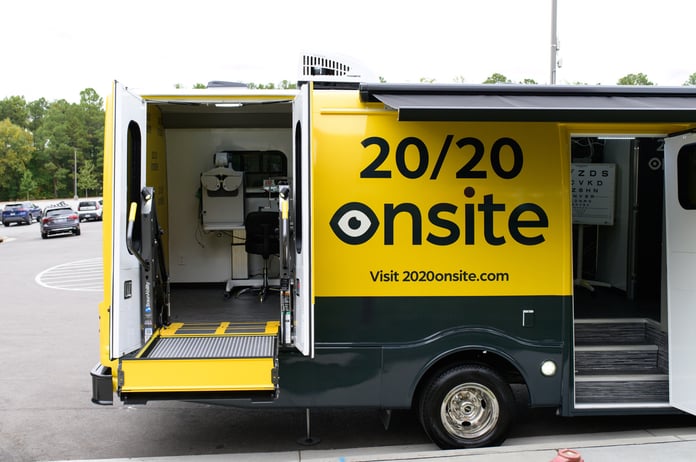
Sponsors, CROs, and clinical operations teams evaluating a decentralized or hybrid trial have three mobile ophthalmic assessment options to choose from: a fully mobile clinic, a semi-permanent exam space, or equipment and staff brought into a site's existing rooms. 20/20 Onsite offers all three, alongside the digital tools that support data capture across a decentralized trial more broadly.
Point-of-Need Delivery Models for Ophthalmic Assessments
20/20 Onsite's three delivery models cover most site and study configurations. Mobile Vision Clinics (MVCs) are fully equipped clinics on wheels that travel between locations. Mobile Vision Pods (MVPs) are semi-permanent exam spaces deployed at one site for a study's full duration. Mobile Clinic Suites (MCSs) bring ophthalmic equipment and certified staff into a site's own existing exam rooms.
Which model fits depends on the trial's shape. A single-visit study spread across many sites tends to favor an MVC, and 20/20 Onsite's MVCs have logged over 200,000 miles across 48 states in the past year alone. A multi-year study concentrated at one or two sites tends to favor an MVP. A site that already has exam rooms but not the specialized staff or equipment tends to favor an MCS.
These three options sit alongside a broader distinction in clinical trial models: fully decentralized trials, where nearly all activities occur outside a traditional site, and hybrid clinical trials, which combine remote elements with in-person visits for assessments that still require them. Most ophthalmic studies land on the hybrid side of that line, which is why the delivery model chosen for eye exams matters as much as the decentralized tools used everywhere else in the protocol.
Why Mobile Ophthalmic Options Matter for Decentralized and Hybrid Trials
In September 2024, the FDA issued its final guidance, Conducting Clinical Trials With Decentralized Elements, defining a decentralized clinical trial (DCT) as one where trial-related activities occur at locations other than traditional sites. A 2024 comparative review in Translational and Clinical Pharmacology found that both the FDA and the European Medicines Agency (EMA) evaluate decentralized elements on the same two axes: patient safety and data integrity. In the same review of 4,874 DCT cases on ClinicalTrials.gov, 'mobile' was the single most common decentralized-trial keyword, appearing in 36.2% of cases.
Ophthalmology has its own reason to lean on mobile options. A workforce study in the journal Ophthalmology projects a 30% supply-and-demand mismatch for ophthalmologists by 2035, with non-metro areas facing far lower workforce adequacy than metro areas. Bringing certified ophthalmic staff to a trial's participants, rather than routing participants to a limited pool of specialists, is one direct way a decentralized or hybrid model can work around that gap.
What Objective Ocular Endpoints Can Move Off-Site, and What Still Needs Point-of-Need Execution
Visual acuity (BCVA), optical coherence tomography (OCT), and intraocular pressure (IOP) remain the three most common objective ocular endpoints in clinical trials, and each carries different feasibility for remote or home-based collection.
BCVA can be captured on a validated digital tool in some decentralized models, including smartphone-based applications, but lighting, testing distance, and instructions still need to be standardized and supervised to produce trial-grade data. OCT has no viable fully remote path today. The equipment requires calibration and trained positioning that a participant can't replicate at home, which is why OCT-heavy endpoints, including monitoring for age-related macular degeneration, are typically reserved for point-of-need visits. IOP testing can work in select fully remote models for stable patients, such as those with diagnosed glaucoma, using a rebound tonometer with proper training, but most trials still route IOP through a mobile or on-site visit for consistency.
In practice, this means most ophthalmic clinical trials end up as hybrid clinical trials rather than fully virtual ones: some assessments handled through telemedicine or patient-reported outcomes, and the objective ocular endpoints handled through one of the point-of-need delivery models above.
Data Capture and Regulatory Fit Across Models
A decentralized or hybrid ophthalmic trial typically layers several data-capture methods onto the assessment itself: eConsent for remote enrollment, patient-reported outcomes for symptom and quality-of-life tracking between visits, and remote patient monitoring via digital health technologies for participants between in-person assessments.
Each layer serves a different purpose. eConsent moves enrollment paperwork off-site without touching the clinical assessments themselves. Patient-reported outcomes capture how a participant is doing day-to-day, which matters for conditions like glaucoma that progress slowly between visits. Remote patient monitoring can flag a change worth an earlier in-person look, but it doesn't replace the calibrated equipment a diagnosis or endpoint measurement still requires.
Whichever mix a protocol uses, the systems capturing and submitting ocular endpoint data still need to meet 21 CFR Part 11 requirements, the FDA's rule covering electronic records and signatures in regulated studies. 20/20 Onsite's point-of-need units follow those requirements, maintaining a 98% data accuracy submission rate across its point-of-need model overall.
How 20/20 Onsite Fits Into a Decentralized or Hybrid Model
20/20 Onsite doesn't run a decentralized trial platform. It supplies the specialized ophthalmic execution, staff, equipment, and calibration that a sponsor's or CRO's own decentralized or hybrid model needs for the ocular endpoints a platform alone can't collect.
That execution role extends beyond ophthalmic-primary studies. 20/20 Onsite has also supported Phase 1 trials where ocular safety assessments were part of a broader non-ophthalmic protocol, applying the same point-of-need model to keep those assessments on schedule.
Citing its own internal trial data, 20/20 Onsite's point-of-need model overall has produced a 9% participant dropout rate, compared with an industry average near 30%.
Talk to a Team That Executes All Three Models
The right mobile ophthalmic assessment option depends on the trial's design, site footprint, and endpoints, not a one-size answer. 20/20 Onsite can help scope which of its three delivery models, or which mix, fits a specific decentralized or hybrid protocol.
FAQs
What Is a Decentralized Clinical Trial (DCT)?
A decentralized clinical trial is a study where trial-related activities happen at locations other than a traditional clinical trial site, using telemedicine visits, in-home visits, or local healthcare providers, per the FDA's September 2024 final guidance.
What Are the Key Components of a Decentralized Clinical Trial?
Common components include eConsent, telemedicine visits, remote patient monitoring through digital health technologies, patient-reported outcomes, and point-of-need clinical assessments for endpoints that can't be captured remotely, such as most objective ocular endpoints.
What Is an Ophthalmic Assessment?
An ophthalmic assessment is a standardized eye exam or diagnostic test used to measure a clinical trial's ocular endpoints, such as visual acuity, OCT imaging, or IOP, using calibrated equipment and certified staff.
How Common Are Decentralized Clinical Trials?
A 2024 review identified 4,874 DCT cases on ClinicalTrials.gov, with annual increases since 2020, according to Translational and Clinical Pharmacology. Decentralized elements are now common enough that the FDA and EMA both maintain standing guidance for them.
How Do Mobile Ophthalmic Assessments Work in Decentralized Clinical Trials?
A certified technician or optometrist performs the assessment using calibrated point-of-need equipment, either at the participant's location, a semi-permanent site-based space, or a site's existing exam room, and the resulting data is submitted through systems that meet 21 CFR Part 11 requirements.
How Are Mobile Technologies Used for Ophthalmic Assessments in Decentralized Clinical Trials?
Beyond the point-of-need equipment itself, decentralized ophthalmic trials often use smartphones or tablets for eConsent and patient-reported outcomes, and remote monitoring apps between in-person visits, while the objective ocular endpoints stay on calibrated clinical-grade equipment.
How Will the Ophthalmologist Shortage Impact Ophthalmic Assessment Options in Decentralized Trials?
With ophthalmology facing a projected 30% workforce shortage by 2035, trials that depend on a local ophthalmologist for every visit face a shrinking pool of available specialists, particularly outside major metro areas. Point-of-need models reduce that dependency by bringing certified staff to the trial rather than routing participants to a fixed pool of local providers.