


Key Takeaways
-
A failed OCT scan in retina clinical trials does not just cost a rescan. It costs a visit window, a deviation filing, and sometimes the patient.
-
The invoice never shows full damage. The real losses are missed timepoints, query backlogs, and dropout risk that never appear in a budget review.
-
A 2024 study across 87 retina trials found imaging findings drove 44.5% of all screen failures, the single largest failure category in the dataset. (Source: Ophthalmology Retina, https://pubmed.ncbi.nlm.nih.gov/38810882/)
-
Most re-acquisition events trace back to decisions made before imaging day: training gaps, acquisition settings not locked to the imaging charter, and no real-time QC.
-
Bringing imaging to patients removes the scheduling pressure that degrades retinal imaging quality at most sites and cuts dropout rates from 30% to approximately 9%. (Source: 20/20 Onsite, 2020onsite.com/clinical-trial-solutions).
Retina Clinical Trials: The Real Cost of Image Re-Acquisition
You budgeted for the rescan. You did not budget for what comes after it.
Many sponsors running retina clinical trials can tell you their screen failure rate. Far fewer track re-acquisition rates with the same discipline.
That gap is expensive. Not because the rescan itself costs a lot. But because of everything the rescan sets off, the protocol deviation that gets filed, the data query that opens, the visit window that closes, and occasionally, the patient who has a reason to leave.
In retina clinical trials, imaging is not a supporting measure. It is the primary endpoint. A failed OCT scan is not a gap in the dataset. It is a missing verdict on whether the drug worked on that visit.
That makes re-acquisition a different category of problem. And it makes the full cost of getting it wrong far higher than most budget reviews ever reflect. What closes that gap is not another imaging vendor. It is one accountable partner for imaging quality from protocol through acquisition.
What Is Image Re-Acquisition and Why Does It Happen in Retina Trials?
Re-acquisition happens when an image captured at a site cannot be used. The reading center rejects it against the grading criteria. Or site QC catches it first. Either way, the image is out of the endpoint dataset, and the patient has to return.
In most therapeutic areas, imaging is a safety check. In retina clinical trials, it is the endpoint itself. OCT scans, fundus photographs, and fluorescein angiograms are not supporting evidence. They are the primary proof that a drug is working.
When those images fail, you're left with a missing verdict on efficacy. That changes every calculation about what a rejection actually costs. It is also why you need one accountable partner for imaging quality, not a vendor who shows up on scan day, but end-to-end ownership from protocol through acquisition.
Why is Retina Uniquely Exposed?
Retina patients can be older and more medically complex than most trial populations. A 2024 study in Ophthalmology Retina reviewed 87 retina trials. Imaging findings drove 44.5% of all screen failures. That was the single largest failure category in the entire dataset.
OCT retinal imaging is also technique sensitive. Signal strength, centration, motion artifact, and dilation consistency: each can produce an image that looks fine on the technician’s screen but fails the reading center’s grading criteria.
The gap between good-enough protocol compliance and true compliance is wide. It is invisible to anyone not trained to close it. Closing it requires single-call accountability, someone responsible for every step, not just the equipment.
Rejected vs. Re-Acquirable
Not every rejection is recoverable. If the visit window closes before a rescan happens, the timepoint is gone. Also, if the imaging charter disqualifies the re-acquisition conditions, the image cannot be replaced. What looks like a scheduling problem becomes a permanent endpoint gap. And a protocol deviation that follows the submission all the way to regulatory review.
The Visible Costs Most Sponsors Already Know
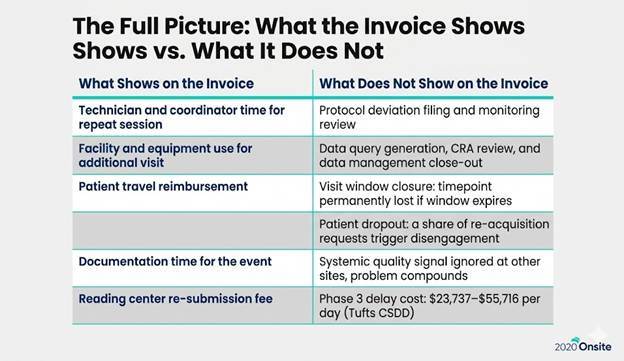 Sponsors see the invoice. They miss the bill.
Operations teams know the surface math. A re-acquisition costs staff time, coordination, a visit slot, and patient reimbursement. In a busy site, those resources are already stretched.
Most sponsors account for:
- Technician and coordinator time for the repeat session
- Facility and equipment use for the additional visit
- Patient travel reimbursement
- Documentation for the event
- Reading center re-submission processing
For one event, manageable. For a 20-site trial with a 10% re-acquisition rate across 150 patients, not small (Source: https://bmjopen.bmj.com/content/7/3/e015276). But even that math is still only what shows up on an invoice.
Quick question: Does your trial currently track the re-acquisition rate with the same rigor as screen failure rate? If not, you are managing only half the risk.
The Hidden Costs That Quietly Derail Retina Trials
The rescan is not the cost. Everything the rescan triggers is the cost.
Failed retinal imaging sets off a chain. Most of that chain never shows up in a budget.
1. Missed Windows and Protocol Deviations
Retina trial imaging runs on strict timepoint windows. Screening OCTs must happen within defined day ranges. Follow-up scans must align with treatment visits. When re-acquisition bumps against those windows, you do not just get an imperfect image. You get a protocol deviation.
Each deviation requires documentation, sponsor notification, and often a monitoring review. A pattern of imaging-related deviations raises questions about site quality control. Sponsors do not want to answer those questions in front of a regulatory review committee.
2. The Query Backlog Nobody Budgets For
Every rejected image generates a data query. The site responds. The CRA reviews. Data management closes it. If the rescan happens under different conditions than the original attempt, a second round of queries follows.
In a trial with multiple medical imaging in clinical trials, timepoints per patient, even a modest rejection rate, produce query volume that delays database lock. The Study of Drug Development (Tufts CSDD) estimates a single Phase 3 delay day costs from $23,737 to $55,716. Imaging-related query backlogs feed those delays more than most sponsors realize.
3. The Patient Who Does Not Come Back
This is the cost that never makes it onto a spreadsheet.
Retina trial patients average in their mid-to-late 70s (Source: https://retinatoday.com/articles/2021-nov-dec/long-term-outcomes-of-anti-vegf-therapy). Many have reduced mobility. Further, many rely on caregivers. However, few manage multiple conditions. Hence, getting to a site is not easy.
When the coordinator calls to ask them back because an image failed to load, some say yes. Some do not.
The industry standard dropout rate is around 30%. 20/20 Onsite’s mobile model reduces that to approximately 9%. Because reducing patient burden is the most direct lever on retention. Every re-acquisition request is a burden. A measurable share of them accelerates the dropout. That share has a real cost: more recruitment, longer timelines, and lost data continuity.
4. The Systemic Signal Most Sites Miss
One re-acquisition at one site often means the same gap exists at other sites that have not yet surfaced it. Site initiation visits deliver the same training. Technicians go through the same certification. If a clinical trial data quality gap exists at Site A, the odds are strong that it exists at Sites B through F.
Sponsors who treat re-acquisition as isolated incidents miss the window to intervene before the problem scales. That window stays open when you have one accountable partner monitoring quality across every site, not a vendor you call after the rejection arrives.
Here is how the hidden costs stack up: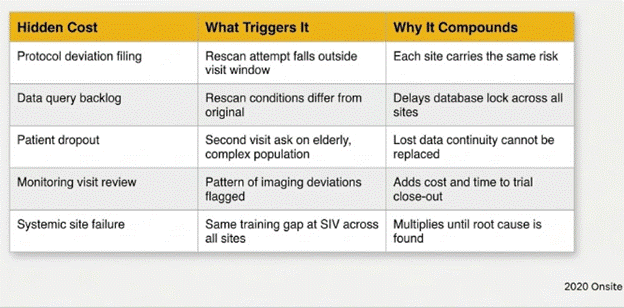
Root Causes: Where Retinal Imaging in Clinical Trials Goes Wrong
The image did not fail because of bad luck.
It failed because of a decision made earlier. In training. In setup. In scheduling. These are the specific failure modes that drive re-acquisition in retina clinical trials:
1. Acquisition Settings Not Locked to the Imaging Charter
Every retina trial has an imaging charter. It specifies scan type, acquisition parameters, signal thresholds, and required views. Those specs exist because the reading center needs consistent data to make endpoint calls.
At the site level, the picture is often different. A technician uses a slightly different scan density. Software defaults change after an OS update. A scan protocol gets swapped because the standard one runs too long for the visit schedule.
None of these feel-like violations in the moment. All of them can produce images that the reading center cannot grade.
2. OCT Software Version Drift Across Sites
Retinal imaging technology moves fast. OCT segmentation algorithms are version-specific. A software update at one site can change how the device processes layer thickness measurements. Subtly enough that no one notices until the reading center flags inconsistencies across visits or sites.
Version control in most sites is managed by whoever handles the equipment. Not whoever manages the trial. The result is an uncontrolled drift.
It surfaces as data noise or rejection spikes only after the damage is done. End-to-end ownership means this is governed before the first patient visit, not flagged after the 10th rejection.
3. No Real-Time QC Before the Patient Leaves
The most expensive five minutes in retinal imaging are the five minutes nobody takes.
Real-time image review checks centration, signal strength, and completeness against the imaging charter while the patient is still present. It is the single most effective step for preventing rejection in retinal clinical trials. It is also the most inconsistently applied. It requires trained eyes and a visit to the workflow that treats QC as a built-in step, not an afterthought. That is the difference between a vendor and a partner with single-call accountability.
4. Technician Requalification Treated as Optional
Initial training covers mechanics. It does not protect against what happens six months later.
When enrollment pressure compresses visits, staff turns over, or a technician has been doing it their way long enough that the deviation feels normal, training alone does not hold. Requalification does.
Technique-sensitive endpoints drift when the people performing them are not periodically requalified. In retina clinical trials, that drift shows up in the rejection rate. Often with no single obvious cause.
5. Scheduling Pressure as an Imaging Quality Problem
A technician with 12 minutes to complete an OCT in a packed visit schedule is not going to re-center a scan, manage patient fixation, or repeat a B-scan with motion artifact.
Scheduling pressure is a clinical-trial imaging-quality problem. It just does not show up in the data until the read center sends its report two weeks later.
How to Prevent Image Re-Acquisition Before It Starts?
The intervention window is before enrollment opens. Not after the first rejection arrives. Every step below is owned by an end-to-end partner before the first patient walks in. Here is what prevention actually looks like in practice:
1. Lock Acquisition Workflows to the Imaging Charter at Site Initiation
The imaging charter should be the operational backbone of every imaging visit. Train technicians to read the reading center grading criteria, not just the equipment manual. Require them to demonstrate compliant retinal image analysis workflows before they perform independent trial imaging. This is not a one-time handoff. It is end-to-end ownership of acquisition quality starting at day one.
2. Build Real-Time Image Review into Every Visit
Add a QC checkpoint to every imaging visit. Before the patient leaves, a trained reviewer checks the image against charter criteria: signal strength, centration, required views, and scan completeness. When problems are caught in real time, they are resolved in real time.
3. Treat OCT Software Version Control as Trial Governance
Version changes need documentation, approval, and endpoint impact review before they are applied. Assign ownership to someone who understands the relationship between retinal imaging technology versions and segmentation output. Build version checks into monitoring visits.
4. Requalify at Trial Milestones, Not Just Onboarding
Schedule requalification at defined enrollment milestones. Technique drift is predictable and preventable.
When staff turn over, requalification should be automatic, not optional.
5. Use Re-Acquisition Events as Quality System Signals
The first rejection at a site should trigger a root cause review, not just a rescan. Is the same condition present at other sites? Is there a pattern across medical imaging in clinical trials timepoints? Treating each rejection as a system signal catches problems before they scale.
Think about your last trial: If one site had a reading center rejection spike, did you check whether the same acquisition gap existed at your other sites, or did you treat it as a one-of?
How 20/20 Onsite Protects Retinal Imaging Quality in Clinical Trials?
Sponsors do not need another imaging vendor. They need one accountable partner with end-to-end ownership of imaging quality from protocol through acquisition.
20/20 Onsite supports sponsors and CROs running retina clinical trials with standardized acquisition, real-time QC, and point-of-need delivery. Here is what that looks like in practice.
1. Imaging Charter Alignment from Day One
Every 20/20 Onsite engagement starts with a review of the imaging charter and reading center expectations. Acquisition protocols are built to those specifications before the first patient visits. Technicians are trained in the grading criteria, not just in equipment operation. Medical imaging in clinical trials requires that standard. We hold it. That is what single-call accountability means from day one.
2. Real-Time QC Built into Every Visit
20/20 Onsite clinical teams review images before patients leave the mobile clinic. This is not a remote monitoring function. It is a built-in step. Performed by trained ophthalmic professionals who know what protocol-compliant OCT retinal imaging looks like and can act on it while the window is still open.
3. Point-of-Need Delivery Removes the Root Cause
OCT retinal imaging fails when technicians are rushed; patients are worn out, and visits are crammed into clinics not designed for research imaging.
20/20 Onsite’s Mobile Vision Clinics bring imaging directly to patients. The environment is controlled. The equipment is standardized. The visit is centered on imaging.
Across 100,000-plus patient visits, that model has produced a 91% patient retention rate. The industry standard is 70%. (Source: 2020onsite.com/clinical-trial-solutions) It has also produced clinical trial data quality that sponsors cannot reliably achieve when site-scheduling pressure dictates the acquisition pace.
4. Quality Monitoring That Catches Drift Before It Scales
When a quality issue surfaces at one site, 20/20 Onsite treats it as a signal about the system. Quality trends are monitored across visits and sites. When a drift appears, the response is corrective action before the next visit. No documentation after the next rejection. This is what end-to-end ownership looks like in practice.
What This Actually Looks Like in Practice?
The theory is clean. Reality is messier. Here is what better retinal imaging operations actually look like.
One CRO was conducting a Phase 1 study when a critical ophthalmology piece of equipment failed at the vendor's site. The trial stalled. Patients were already traveling 45 minutes each way from the Phase 1 site to the ophthalmology clinic. With the equipment down, the entire study stopped.
The sponsor didn't wait for repairs. They brought in 20/20 Onsite's mobile clinic directly to the Phase 1 site. Equipment failure became irrelevant. Patient travel dropped to zero. Scheduling frustrations disappeared. The trial restarted within days instead of weeks.
This example shares the same pattern. The problem was treated as a signal, not a matter of blame. The team didn’t wait for the vendor to fix the equipment. They fixed the system. And the data held. That is single-call accountability, one partner, end-to-end, from protocol to acquisition.
Moving to Reduce Re-Acquisition Rates in Your Retina Trial
If your program includes OCT or other retinal imaging endpoints and you are seeing early signs of rejection rates, missed windows, or growing query volumes, the fastest path forward is one accountable partner for imaging quality from protocol through acquisition, not just another imaging vendor, but a team with single-call accountability and end-to-end ownership of every step.
Talk to our team. We will show you exactly where re-acquisition risk lives in your current protocol and what it would take to close it.
FAQs
Q. What percentage of retina trial screen failures are caused by imaging issues?
A. According to a 2024 study in Ophthalmology Retina analyzing 87 retina clinical trials, imaging findings were responsible for 44.5% of all screen failures, making it the largest single failure category. This makes imaging quality the most operationally significant variable in retina trial performance.
Q. How much does a protocol deviation from a failed image actually cost?
- The direct cost of a deviation is documentation, monitoring, review, and coordinator time. The indirect cost is larger: if the imaging-related query backlog delays database lock and pushes a Phase 3 trial by even one day, a Study of Drug Development estimates the cost at $23,737 to $55,716 per day. Multiply that by the number of days a growing query backlog adds to your lock timeline.
Q. Can a re-acquisition event cause a patient to drop out?
A. Yes. Re-acquisition requests add burden to patients who are often elderly, mobility-limited, and manage multiple conditions. Every unplanned return visit increases the likelihood that a patient will reconsider continued participation. Trials with high re-acquisition rates show a measurably higher dropout risk, particularly in retina populations, where the demographic profile makes travel logistically challenging.
Q. What is the most effective way to reduce re-acquisition rates in retina trials?
A. The highest-impact intervention is a real-time image review before the patient leaves the visit, catching failed images while there is still time to resolve them within the visit window. Combined with acquisition settings locked to the imaging charter at site initiation and regular technician requalification, most re-acquisition events become preventable rather than manageable.
Q. How does point-of-need imaging delivery reduce re-acquisition risk?
A. Point-of-need delivery removes the scheduling pressure that is the primary driver of acquisition errors at traditional sites. When imaging visits are built around the imaging rather than around a site's existing clinical schedule, technicians have the time and focus to acquire protocol-compliant images on the first attempt. 20/20 Onsite's model also builds real-time QC into every visit, creating a second layer of prevention. Learn more about our ophthalmic clinical trial solutions.