


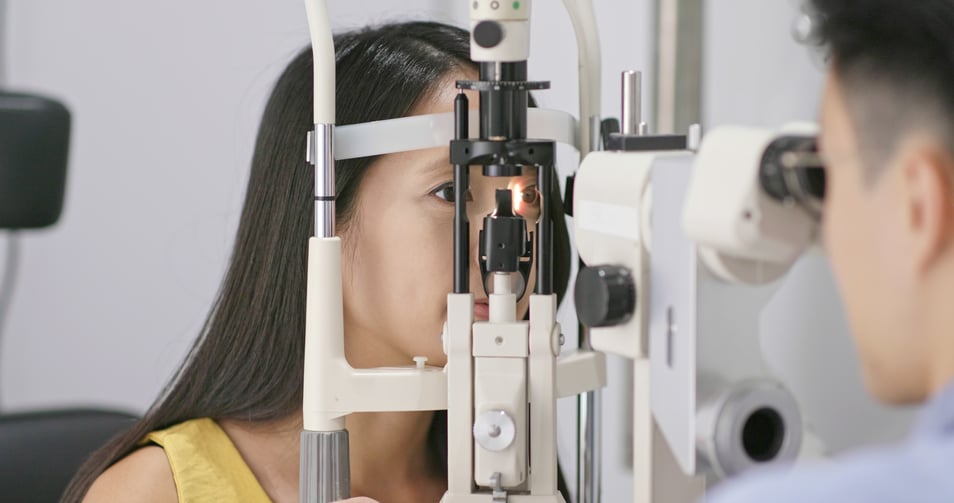
Enrollment delays and retention failures threaten ophthalmic clinical trials. The main issue is execution barriers. Participants cannot access specialized BCVA, IOP, and OCT assessments due to the need for distance travel, frequent visits, and limited site availability.
Traditional site-based models require patients to travel to centralized locations for specialized equipment and certified assessors. This creates an execution gap in ophthalmology research. Who physically performs consistent ophthalmic assessments at scale? That's where enrollment and retention strategies break down.
At 20/20 Onsite, we provide end-to-end ophthalmic trial consultation, clinical field execution, and support. Our point-of-need delivery model brings assessments to participants where they live, work, or congregate. This eliminates geographic and mobility barriers while maintaining execution quality.
The results speak to the impact. Point-of-need delivery achieves 9% dropout versus the 30% standard dropout rate. Participants travel an average of 12 miles compared to 67 miles for traditional site-based trials, an 80.6% reduction in travel burden. We maintain 98% data accuracy and 97% participant satisfaction across point-of-need environments.
The Enrollment and Retention Barrier Gap
Enrollment issues are the leading cause of clinical trial delays. Up to 80% of all studies fail to meet their initial recruitment targets. This problem severely impacts ophthalmic clinical trials and eye disease research.
Why Enrollment and Retention Failures Hit Ophthalmic Trials Harder
In ophthalmic trials, enrollment and retention failures can affect more than participant volume. These studies often depend on repeated BCVA, IOP, OCT, visual acuity, and specialized imaging assessments that require calibrated equipment, trained assessors, and consistent protocol execution. When participants miss visits, drop out, or cannot access assessment locations, study teams may lose critical endpoint data, miss protocol windows, and face added pressure across sites. That is why reducing travel burden, improving access, and maintaining consistent ophthalmic assessment workflows are especially important for protecting trial timelines and data quality.
Enrollment Challenges in Ophthalmic Clinical Trials
These clinical studies require specialized ophthalmic equipment that may not be available in rural areas. This immediately excludes certain demographics and limits your participant pool. Multicenter trials face even greater challenges in coordinating specialized equipment and certified assessors across multiple sites.
Enrollment also suffers due to the nature of the eye conditions involved. Someone with diabetic retinopathy, age-related macular degeneration, ocular hypertension, or optic neuropathy could struggle with vision loss. Patients with corneal conditions, uveitis, or diabetic macular edema may experience similar barriers. Driving may not be possible, which limits access to trial sites.
Pediatric populations face unique enrollment barriers. Children with amblyopia, myopia, or retinal disease require a caregiver to accompany them to appointments. This doubles the logistical burden for families already managing complex eye care needs.
Ophthalmic clinical trials typically require frequent assessments. Patients need quarterly OCT evaluations, monthly IOP measurements, and regular visual acuity testing. Studies involving the retina, vitreous, or cornea may require additional specialized imaging. They may not be willing to commit their time this way.
Screen failure rates tend to be high in these research studies. This can occur when baseline assessments are inconsistent or when specialized medical devices aren't properly calibrated across sites.
Retention Challenges in Long-Term Ophthalmic Studies
The average travel distance for participants in clinical studies is 67 miles. This becomes unsustainable over months or years of repeated assessments. Visit fatigue compounds the problem as patients face monthly or quarterly visits for conditions like glaucoma, AMD, or geographic atrophy.
Aging populations with these eye diseases face mobility limitations. Many rely on caregivers for transportation. Long-term participation becomes infeasible when caregiver availability declines. This is particularly challenging for randomized trials or double-masked studies requiring strict protocol adherence.
Participants in studies for neovascular AMD or intravitreal treatments may require more frequent visits during active treatment phases. The burden increases when trials involve both therapeutic interventions and extensive monitoring protocols.
Site capacity constraints create scheduling delays and missed protocol windows. Patients become frustrated when appointments are delayed or rescheduled. These operational barriers drive dropout in both open-label studies and placebo-controlled trials.
How Point-of-Need Execution Eliminates These Barriers
One of the most effective clinical trial solutions for enrollment and retention barriers is point-of-need execution. This approach supports clinical research across ophthalmology by bringing specialized capabilities directly to participants.
How Point-of-Need Execution Accelerates Enrollment
Point-of-need execution brings calibrated medical devices and trained technicians to participants. Rural areas and underserved communities gain access without requiring participants to travel to specialized eye care centers.
Regardless of the trial phase you're conducting, screening can pose challenges to enrollment. Pre-screening at point-of-need locations helps prevent screen failures and accelerate recruitment. This is particularly valuable for studies targeting rare conditions or specific patient phenotypes.
Point-of-need execution provides flexibility. It accommodates various participants' schedules, thereby improving satisfaction. Evening and weekend assessments reduce the work-life disruption that often prevents enrollment in clinical research.
How Point-of-Need Execution Improves Retention
Point-of-need execution reduces participants' travel by 80.6%. This is particularly important for patients with dystrophies, optic nerve issues, or retinal diseases who have limited visual fields. Those experiencing vision loss from dry eye, corneal conditions, or other ocular diseases benefit significantly.
These patients may rely on others for transportation or depend on public transportation. Point-of-need delivery eliminates that dependency. It prevents missed appointments and improves adherence to protocol windows across different study designs.
Integration Within CRO-Led Trial Operations
Point-of-need strategies must integrate with CRO-led operations to be effective. CROs manage enrollment strategy and trial coordination. We execute ophthalmic assessments at the point of need. This strengthens the execution layer CROs depend on without replacing trial management functions.
Proven Enrollment and Retention Outcomes
Point-of-need execution delivers measurable improvements in ophthalmology clinical trials.
Measured Outcomes
We achieve a 70% improvement in retention with 9% dropout versus 30% industry standard. Travel distance decreases 80.6%, from 67 miles to 12 miles on average. Participant satisfaction reaches 97% while maintaining 98% data accuracy.
These outcomes hold across different therapeutic areas and trial designs. Whether the study focuses on the retina, cornea, or optic nerve, accessible execution improves both enrollment speed and long-term retention.
Case Study Results
Applied Genetic Technologies Corporation (AGTC) faced significant enrollment challenges during the COVID-19 pandemic. The trial focused on gene therapy treatments for X-linked retinitis pigmentosa and achromatopsia.
Enrollment was low, prompting AGTC to work with our team. We helped the trial exceed enrollment goals across 24 states with 150 assessments completed during the pandemic. This demonstrates how point-of-need execution enables access to new treatments for geographically dispersed populations with rare diseases.
We also expanded enrollment among underserved diabetic retinopathy communities. Geographic barriers that previously excluded these populations were eliminated through accessible delivery. This improved diversity in clinical research while expanding access to eye health services.
Application Across Trial Phases and Therapeutic Areas
Point-of-need strategies work across various phases and therapeutic areas in ophthalmology.
Early-Phase Trials
These strategies assist with early-phase trials by improving enrollment. They are particularly helpful for safety assessments with limited site access. Early studies testing new medical devices or novel therapeutic approaches benefit from expanded geographic reach.
Late-Phase and Long-Term Studies
Large Phase III studies require geographic diversity to obtain accurate results. In long studies involving glaucoma, AMD, or geographic atrophy, you need high retention percentages. Point-of-need strategies help prevent dropouts that would otherwise compromise statistical power.
Studies evaluating new treatments for diabetic macular edema, neovascular AMD, or intravitreal therapies often span multiple years. Sustained retention becomes critical when assessing long-term efficacy and safety outcomes.
Rare Disease and Gene Therapy
Finding treatments for rare eye diseases often involves reaching dispersed patient populations.Mobile care allows participants to receive assessments without having to travel for hours.
This approach supports enrollment in studies for rare retinal diseases, inherited corneal dystrophies, and other conditions with small patient populations. It enables clinical research that would be impossible under traditional site-based models.
Pediatric Ophthalmology Research
Pediatric trials for conditions like amblyopia, myopia progression, or congenital eye diseases present unique challenges. Point-of-need delivery reduces the burden on families by bringing assessments to schools, pediatric clinics, or homes.
Financial Impact of Better Enrollment and Retention
Better enrollment and retention impact your trial financially while accelerating access to new treatments.
Reducing Dropout and Timeline Costs
Every participant who drops out costs an average of $19,533 to replace. Mobile care reduces dropout rates from 30% to 9%, saving significant replacement costs across the trial duration.
Better enrollment conversion with these strategies means the cost per participant averages around $6,533. This efficiency matters particularly for studies requiring large sample sizes or targeting rare conditions.
Trial delays can carry significant financial consequences, with sponsor delay impact and lost revenue estimates ranging from $600,000 and $8 million per day in some analyses. By avoiding these delays, you stay on track financially. This timeline protection is critical for maintaining FDA approval schedules and bringing new treatments to market faster.
Operational Efficiency Gains
Coordinating with vendors across multicenter trials can be complex. Single-call accountability resolves issues efficiently. Mobile clinics assist with pre-screening, reducing screen-failure waste, and improving overall enrollment efficiency.
This streamlined approach benefits sponsors conducting research studies across multiple therapeutic areas or running concurrent trials in different geographic regions.
Choosing Ophthalmic Trial Execution Partners
When selecting ophthalmic clinical trial execution partners, keep key capabilities in mind.
Key Capabilities to Verify
Your execution partner must offer specialized ophthalmic equipment that is calibrated correctly. They must provide trained and experienced technicians familiar with protocols for evaluating the retina, cornea, vitreous, and other ocular structures.
You need a partner with nationwide point-of-need delivery capabilities. Pre-screening capacity must be available to assist with enrollment. This is essential for randomized trials or double-masked studies that require consistent execution standards.
Your execution partner should offer an integration model that works with CRO-led operations. The goal is to complement the existing setup, not replace it. They should understand how to support clinical research across different study designs and therapeutic areas.
How 20/20 Onsite Supports Ophthalmic Trial Success
At 20/20 Onsite, we provide comprehensive support for your ophthalmology clinical trials.
Point-of-Need Delivery Model
Our Mobile Vision Clinics are equipped for fundus photography, BCVA, IOP, OCT, and visual field assessments. We have pre-screening capabilities and offer services across 48 states.
We support studies across therapeutic areas, from corneal and retinal diseases to conditions affecting the vitreous and optic nerve. Our teams are trained in protocols for evaluating visual acuity, assessing eye health outcomes, and executing specialized assessments required by different research studies.
Our Track Record for Trial Retention
Our 98% accuracy and 97% satisfaction scores demonstrate the burden we reduce for participants. We decrease travel distance by 80.6% and lower dropout rates from 30% to 9%.
Integration within CRO-led operations strengthens enrollment and retention without replacing trial management. Single-call accountability for ophthalmic endpoint execution simplifies coordination across multicenter trials and complex study designs.
Protect Your Ophthalmic Trial Enrollment and Retention
If you're planning an ophthalmic clinical trial, enrollment and retention are critical. Execution barriers are typically to blame for these challenges. By relying on accessible endpoint execution, you ensure participants don't face logistical or geographic issues that prevent them from staying involved.
Whether your study focuses on age-related macular degeneration, diabetic retinopathy, glaucoma, or other eye diseases, point-of-need delivery expands your potential participant pool. This approach supports clinical research across ophthalmology while improving access to eye care and new treatments.
Request a protocol review and enrollment risk assessment to identify where geographic barriers, visit frequency, or site capacity may limit enrollment speed and retention rates. We can help evaluate accessibility barriers early and build point-of-need execution strategies that expand participation while protecting data quality and regulatory compliance. Schedule a consultation to get started.